Safe Torque Off on a Kinetix 5700: Wiring the STO Connector, and What It Does Not Do
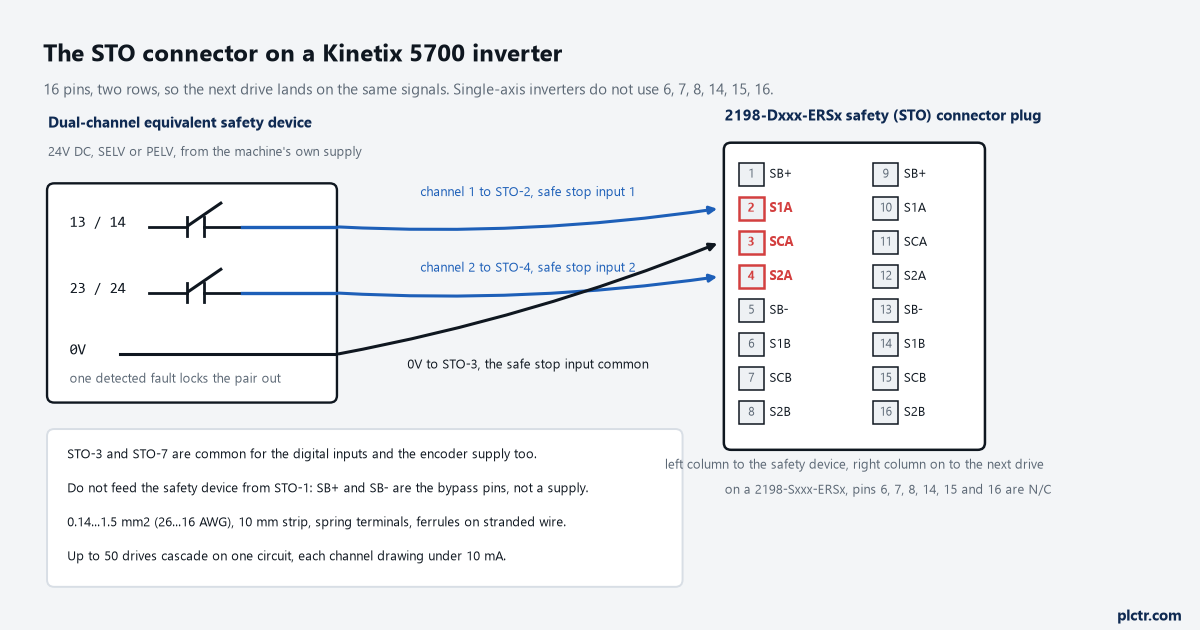
The STO connector on a Kinetix 5700 inverter: a dual-channel safety device with contacts 13/14 and 23/24 feeding STO-2 and STO-4, the supply common landing on STO-3, and the 16 pins of the plug named with their signals

Safe Torque Off on a Kinetix 5700: Wiring the STO Connector, and What It Does Not Do One contact of the gate switch opens a few hundred milliseconds before the other, and a second later a 2198-D032-ERS4 posts GuardStopInputFault. The axis will not come back with a normal fault reset. Both safety inputs have to … Read more
THRSe, TSAM and FSBM: The Four Sensors and the Sequence That Has to Hold

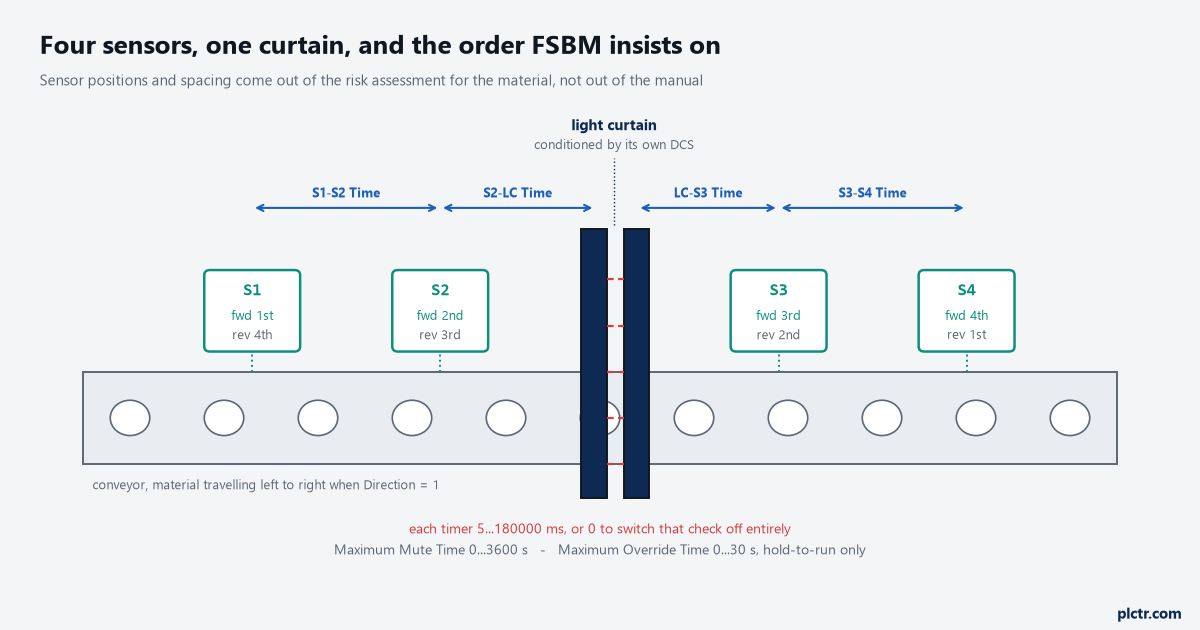
A conveyor in plan with a light curtain in the middle and four muting sensors, S1 and S2 before it and S3 and S4 after it, each labelled with its position in the forward and reverse sequences, and the four timer windows S1-S2, S2-LC, LC-S3 and S3-S4 drawn as spans between them, with the note that each timer is 5 to 180,000 ms or 0 to switch that check off, the Maximum Mute Time is 0 to 3600 s and the Maximum Override Time is 0 to 30 s with a hold-to-run device

THRSe, TSAM and FSBM: The Four Sensors and the Sequence That Has to Hold An FSBM instruction sitting at Fault Code 16#9121 has already told you where to look, and it is not a sensor alignment problem yet. The third digit of that code is the step number: the instruction was in step 2 of … Read more

Good Quality, Stale Value: Diagnosing an OPC Link That Is Lying to You

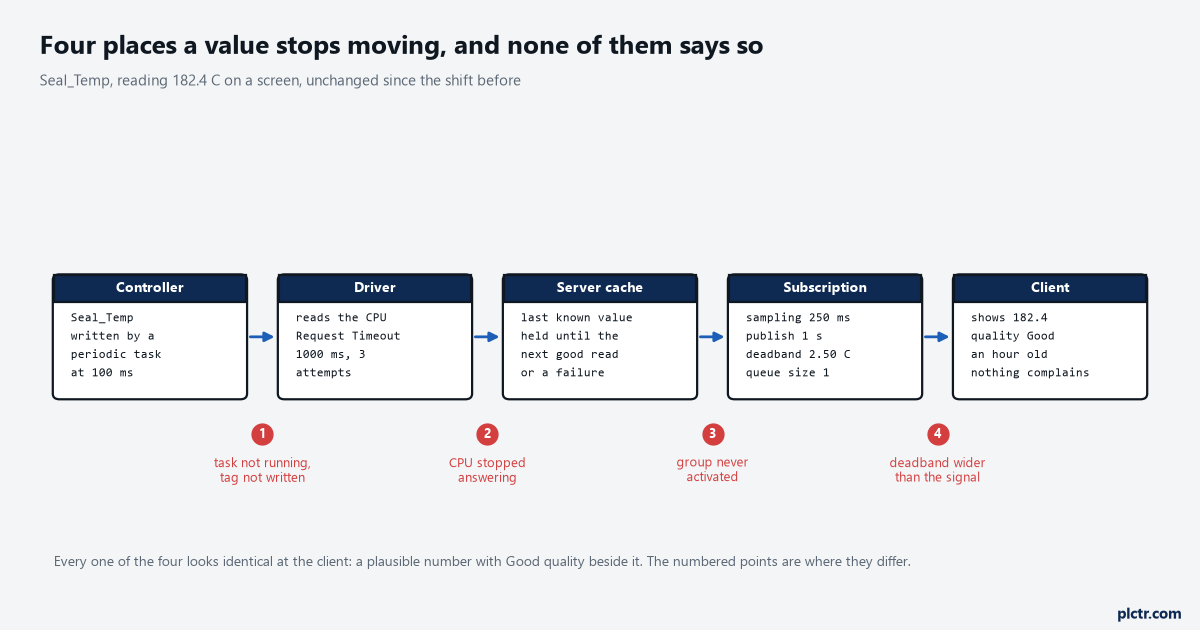
Five boxes in a row from the controller through the driver, the server cache and the subscription to the client, with four numbered red break points marked underneath

Seal_Temp has read 182.4 °C since about 04:00, the quality field next to it says Good, and the trend behind it is a flat line eleven hours long. The bagger has run four product changes in that time and the seal jaws are visibly hot. Nothing on the SCADA is in alarm, nothing in the … Read more

DCS and the Dual-Channel Family: Discrepancy Time, and the Two Faults With No Timer Behind Them

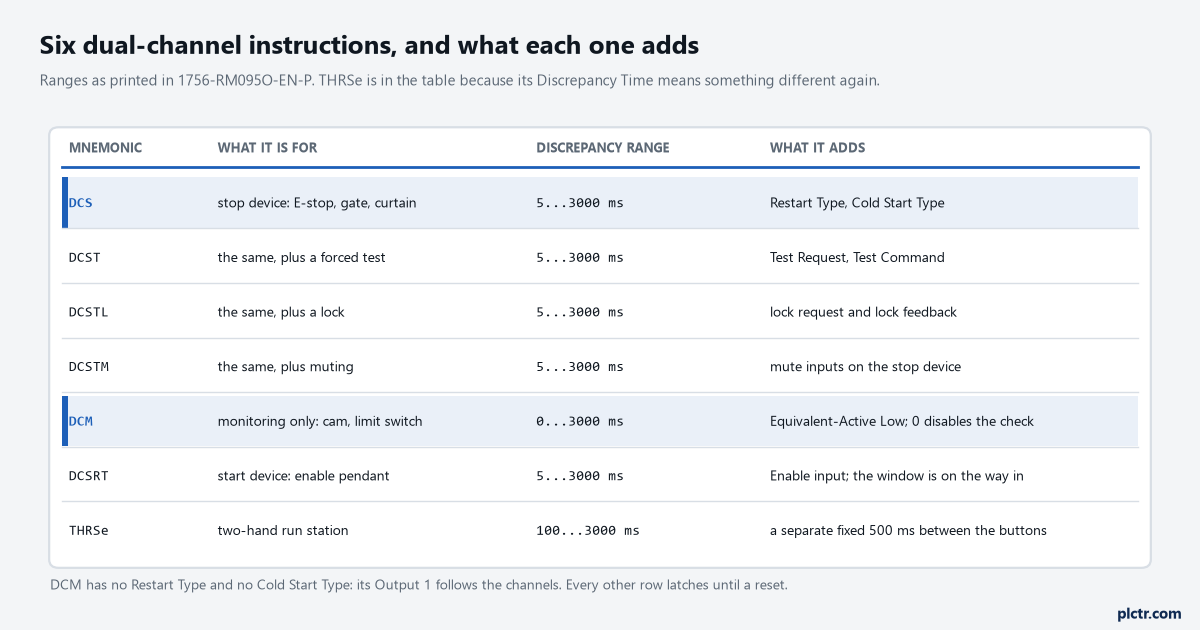
A four-column table of the dual-channel instructions with what each is for, its discrepancy range and what it adds: DCS for a stop device at 5 to 3000 ms adding Restart Type and Cold Start Type; DCST the same plus a forced test; DCSTL the same plus a lock request and lock feedback; DCSTM the same plus muting; DCM for monitoring a cam or limit switch at 0 to 3000 ms, adding an Equivalent-Active Low input type and a zero that disables the check; DCSRT for a start device such as an enable pendant, with an Enable input and a window measured on the way in; and THRSe with a 100 to 3000 ms range that means something different again

DCS and the Dual-Channel Family: Discrepancy Time, and the Two Faults With No Timer Behind Them A DCS instruction reporting Fault Code 16#4002 has not had a discrepancy in the sense anybody means by the word. That code means Channel A went to the safe state and came back to the active state while Channel … Read more

ESTOP and Its Two Reset Inputs: What a Safety Reset Actually Requires

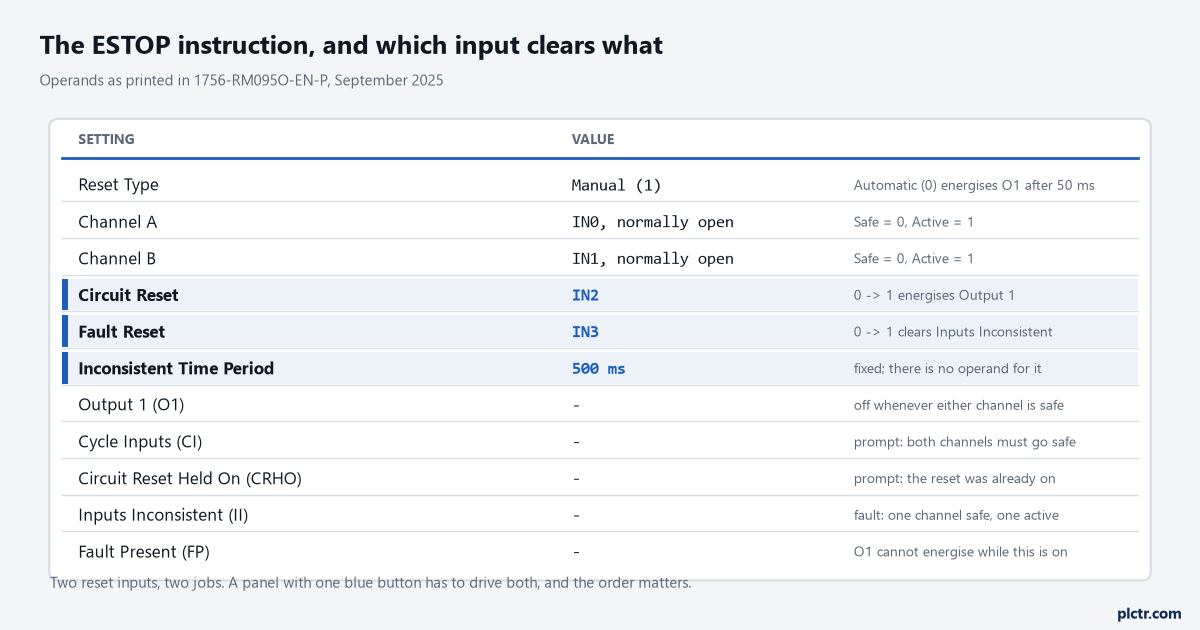
The ESTOP instruction drawn as a panel of operands and values: Reset Type Manual with the note that Automatic energises Output 1 after 50 ms, Channel A on IN0 and Channel B on IN1 both normally open with safe equal to zero, Circuit Reset on IN2 where a zero to one transition energises Output 1, Fault Reset on IN3 where a zero to one transition clears Inputs Inconsistent, an Inconsistent Time Period of 500 ms marked fixed with no operand for it, and the outputs Output 1, Cycle Inputs, Circuit Reset Held On, Inputs Inconsistent and Fault Present with what each one means

ESTOP and Its Two Reset Inputs: What a Safety Reset Actually Requires An ESTOP instruction on a GuardLogix 5580 sitting with Fault Present on and Inputs Inconsistent on will ignore the blue button on the panel for as long as that button is wired to the Circuit Reset operand. Circuit Reset energises Output 1, Fault … Read more

Writing Your First Safety Routine: Standard Tags, Safety Tags, and the Mapping Between Them

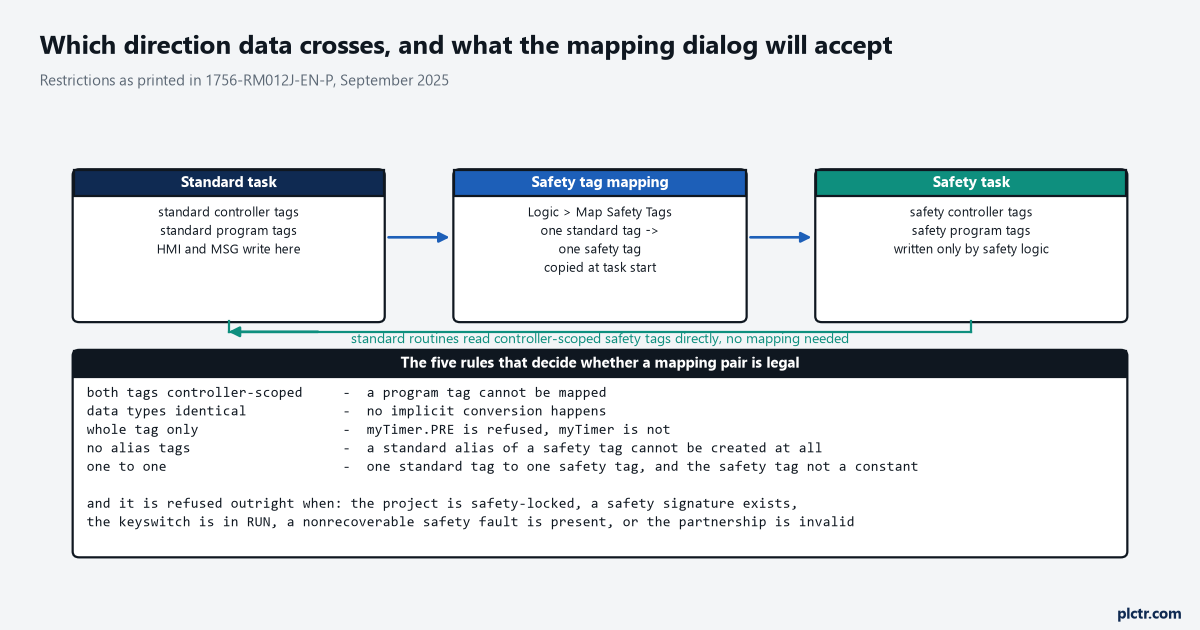
Three boxes across the top showing which way data crosses: Standard task on the left holding standard controller tags, standard program tags and the note that HMI and MSG write here; Safety tag mapping in the middle, reached from Logic then Map Safety Tags, one standard tag to one safety tag copied at task start; Safety task on the right holding safety controller tags and safety program tags written only by safety logic. A return path along the bottom is labelled that standard routines read controller-scoped safety tags directly with no mapping needed. Below, a panel listing the five rules that decide whether a mapping pair is legal and the five states in which mapping is refused outright

Writing Your First Safety Routine: Standard Tags, Safety Tags, and the Mapping Between Them Put a standard BOOL on a rung inside a safety routine and Studio 5000 will not accept it; the browse list does not even offer the tag. Try the obvious workaround next and the software refuses that too, because you cannot … Read more

Scan Rates, Scan Groups and the Deadband That Halves Your Traffic

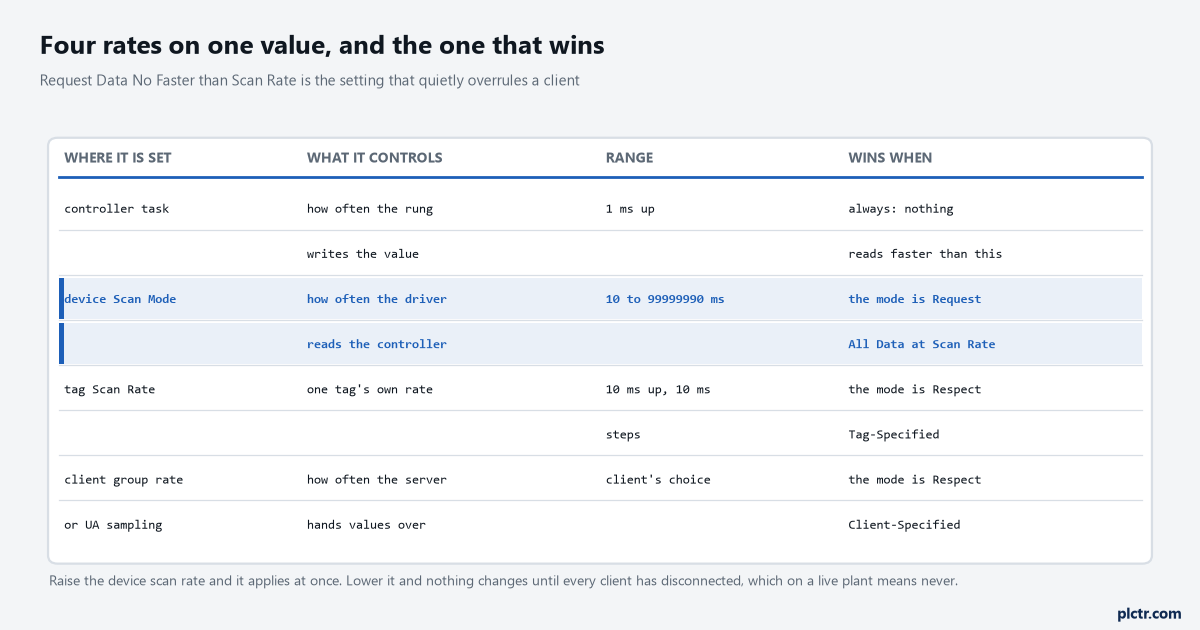
A four-column table listing the controller task, the device Scan Mode, the tag Scan Rate and the client group rate against what each controls, its range and when it wins, with the device Scan Mode rows highlighted

A SCADA client on the TR-14 line subscribes to 1180 tags in one group at 250 ms, which people write down as 4720 value updates a second. Over an hour the server actually delivered 3,832,580 notifications, and 3,744,000 of those came from 260 analogue tags, most of which were sitting still. The 920 digital and … Read more

The Safety Task on a GuardLogix: What Runs In It, What Cannot, and How to Pick the Period

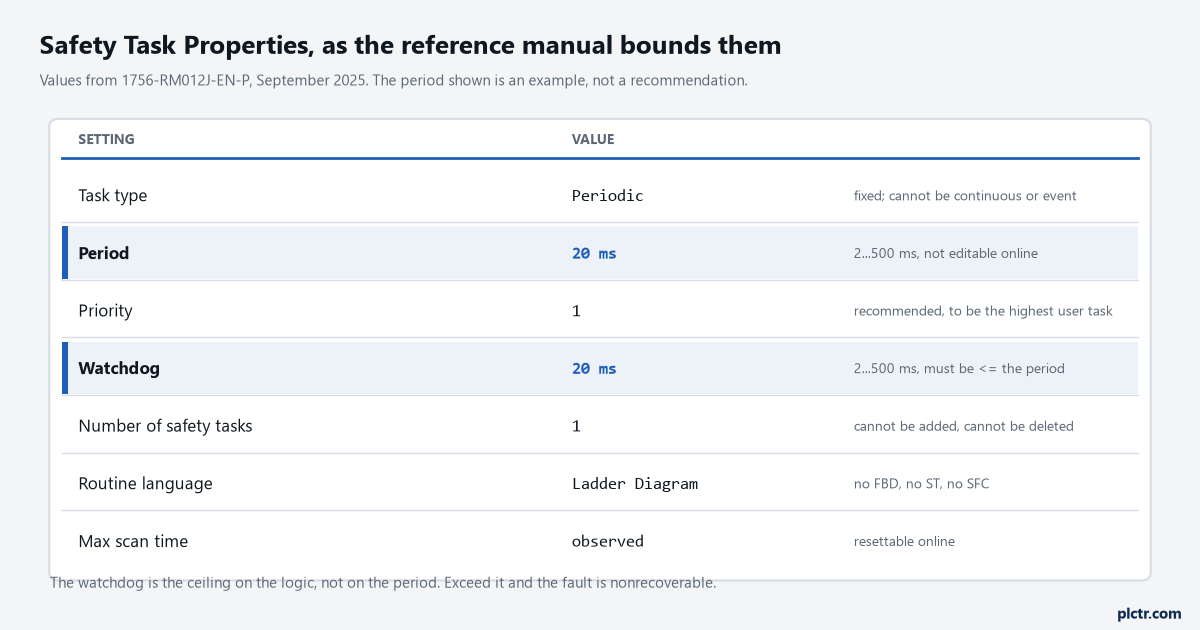
Safety Task Properties drawn as a panel of fields and values: Task type Periodic fixed, Period 20 ms with the range 2 to 500 ms and the note that it cannot be edited online, Priority 1 recommended, Watchdog 20 ms with the range 2 to 500 ms and the requirement that it be less than or equal to the period, one safety task per controller that cannot be deleted, routine language Ladder Diagram only, and the resettable maximum observed scan time

The Safety Task on a GuardLogix: What Runs In It, What Cannot, and How to Pick the Period The Safety Task Properties dialog on a GuardLogix 5580 takes a period between 2 and 500 ms and a watchdog between 2 and 500 ms, and the safety reference manual is explicit that the watchdog has to … Read more

Comparing REAL Values on a ControlLogix: Why EQU Is the Wrong Instruction

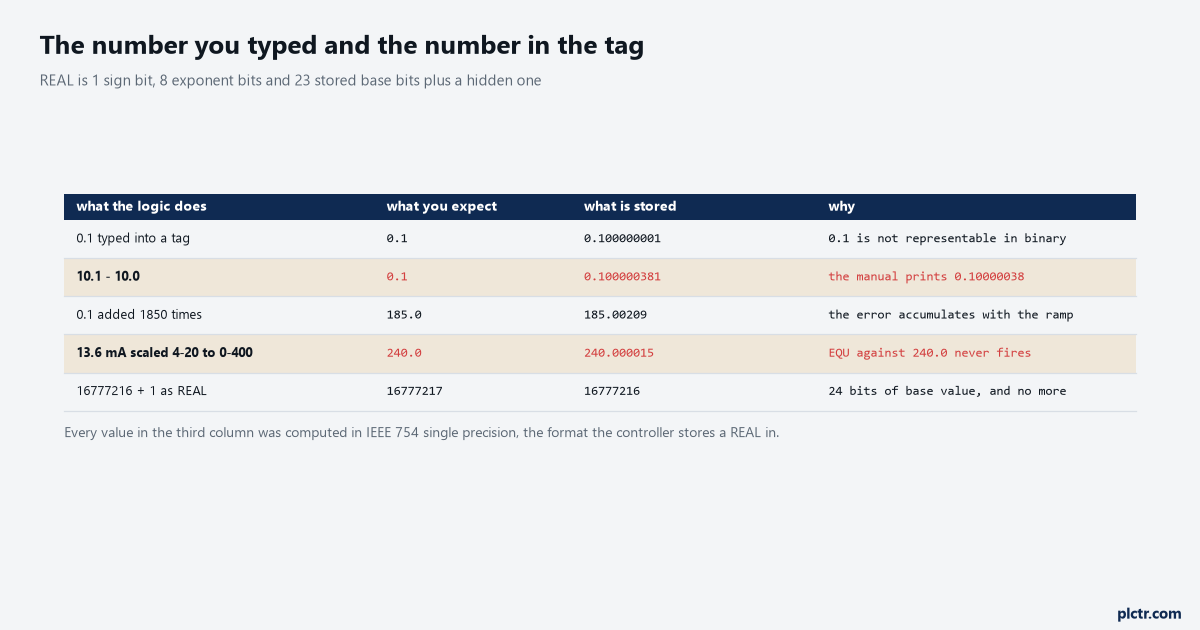
Table of five decimal values against what a Logix REAL actually stores for each, including 10.1 minus 10.0 and 0.1 accumulated 1850 times

Comparing REAL Values on a ControlLogix: Why EQU Is the Wrong Instruction Page 882 of 1756-RM018A carries a worked example nobody quotes: subtract 10 from 10.1 on a Logix controller and the result could very well be 0.10000038, rather than the 0.1 you were expecting. Two pages of guidance later the same manual puts it … Read more

Kepware with a ControlLogix: the Tag Import, the Arrays, and What Breaks

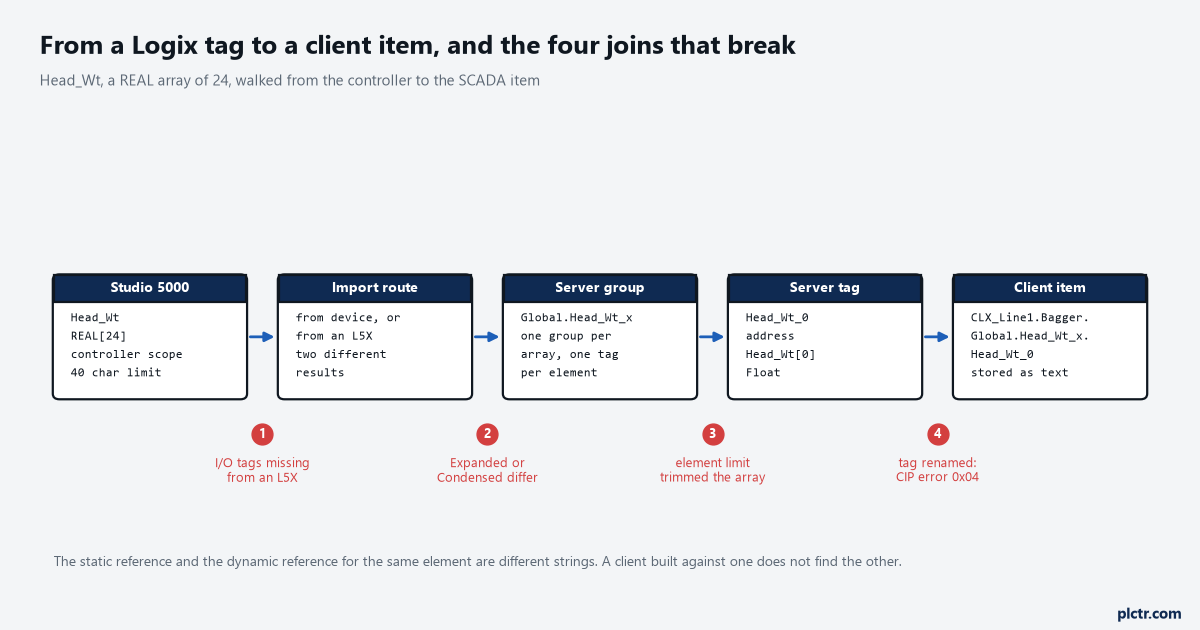
Five boxes in a row from Studio 5000 through the import route, the server group and the server tag to the client item, with four numbered red points marking where each join fails

Automatic tag generation against one 1756-L83E produced 5537 server tags in about ninety seconds, and the clients on that site reference 684 of them. The other 4853 are array elements nobody reads, structure members nobody reads, and a full PID_ENHANCED nobody has looked at since commissioning. They cost project load time, they cost browse time … Read more

Advertisement