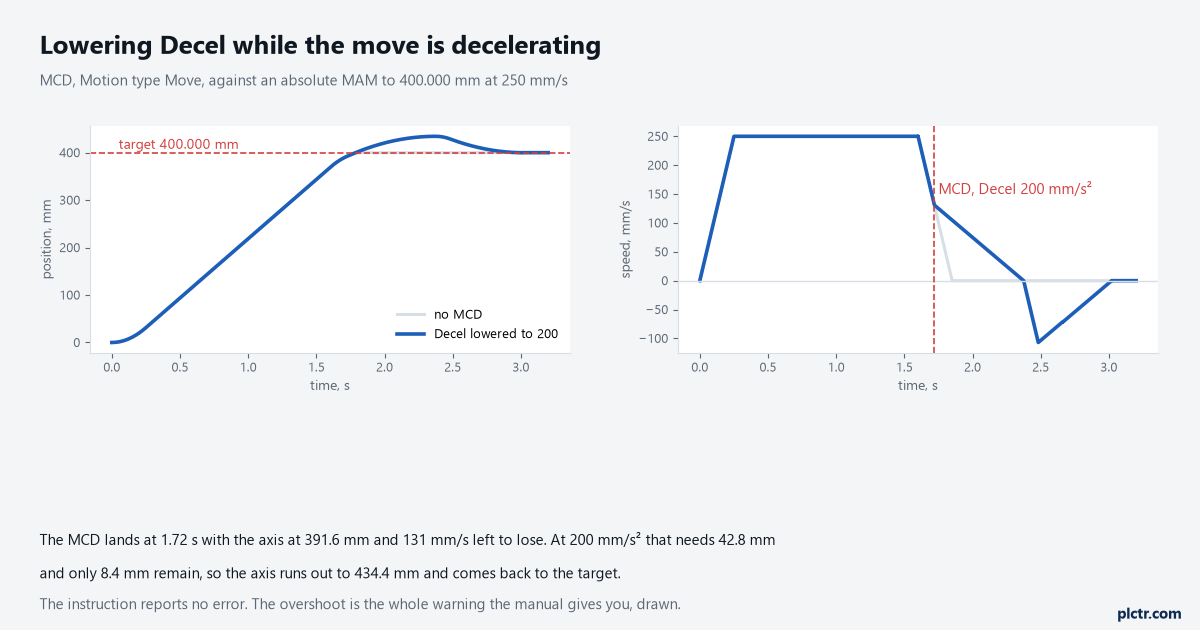
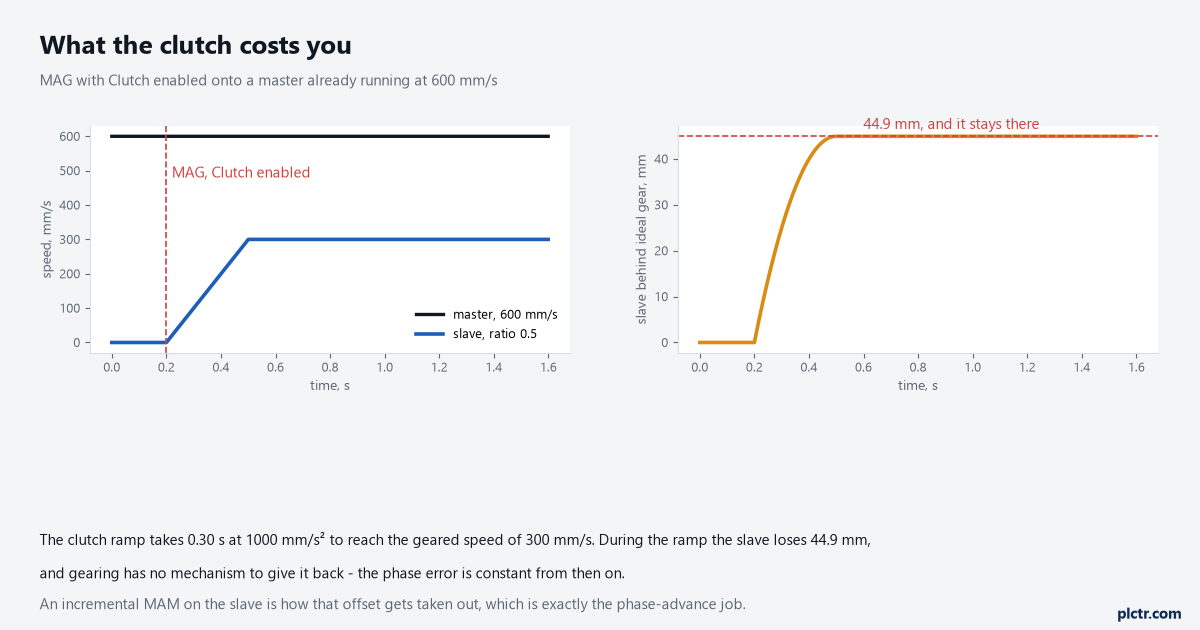
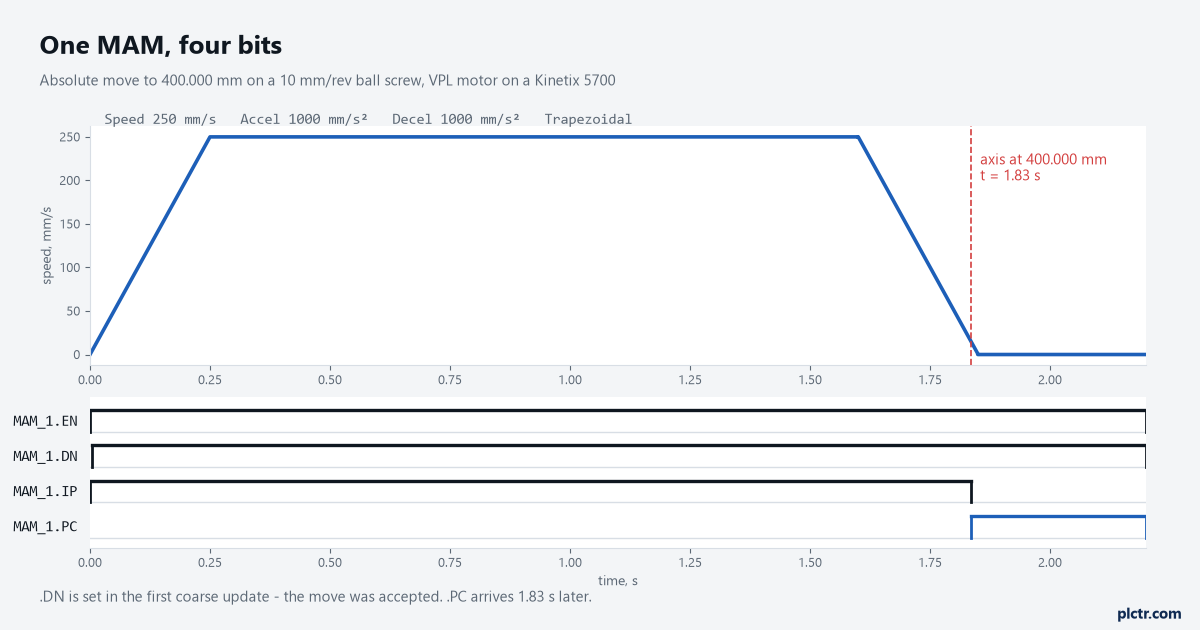
Scaling a Kinetix Axis in Real Units: Position Units, the Conversion Constant and the Gearbox
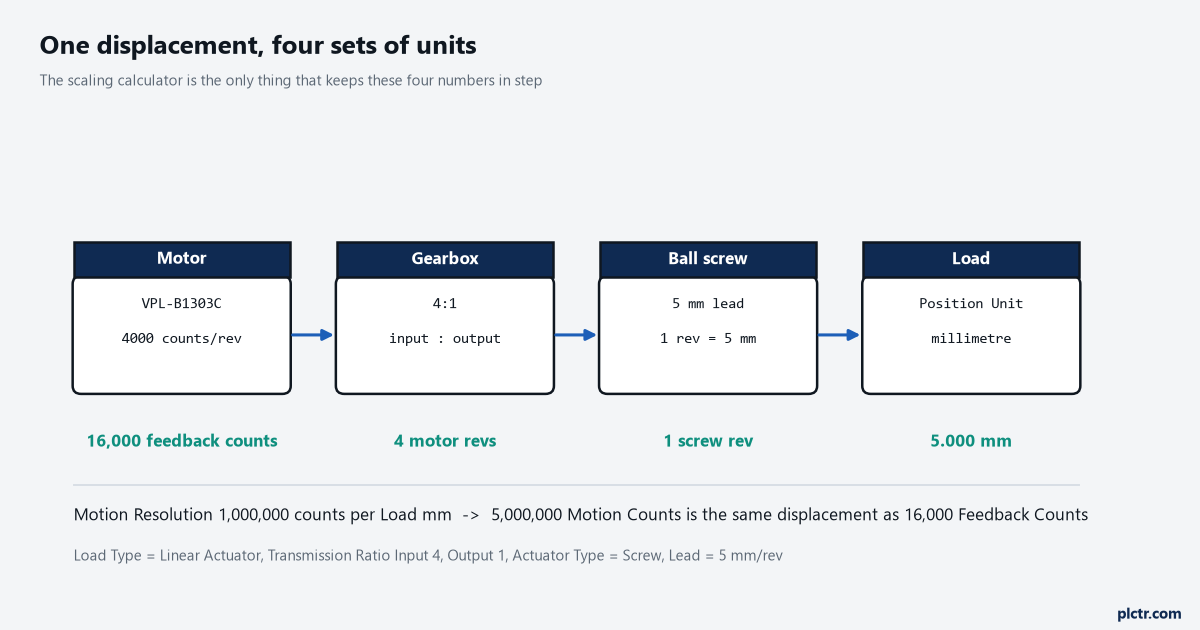
Four boxes left to right with the same displacement written under each: motor VPL-B1303C at 4000 counts per rev showing 16,000 feedback counts, a 4:1 gearbox showing 4 motor revs, a 5 mm lead ball screw showing 1 screw rev, and the load in millimetres showing 5.000 mm

Scaling a Kinetix Axis in Real Units: Position Units, the Conversion Constant and the Gearbox A new Kinetix axis is scaled one Position Unit per motor rev, at 1,000,000 Motion Counts per rev, and on Unlimited travel that axis rolls its position accumulator over after 2,147 revolutions. The motion runs through the rollover perfectly smoothly. … Read more
Tuning a Kinetix 5700 Axis: Load Ratio, Bandwidth and the Autotune That Lies

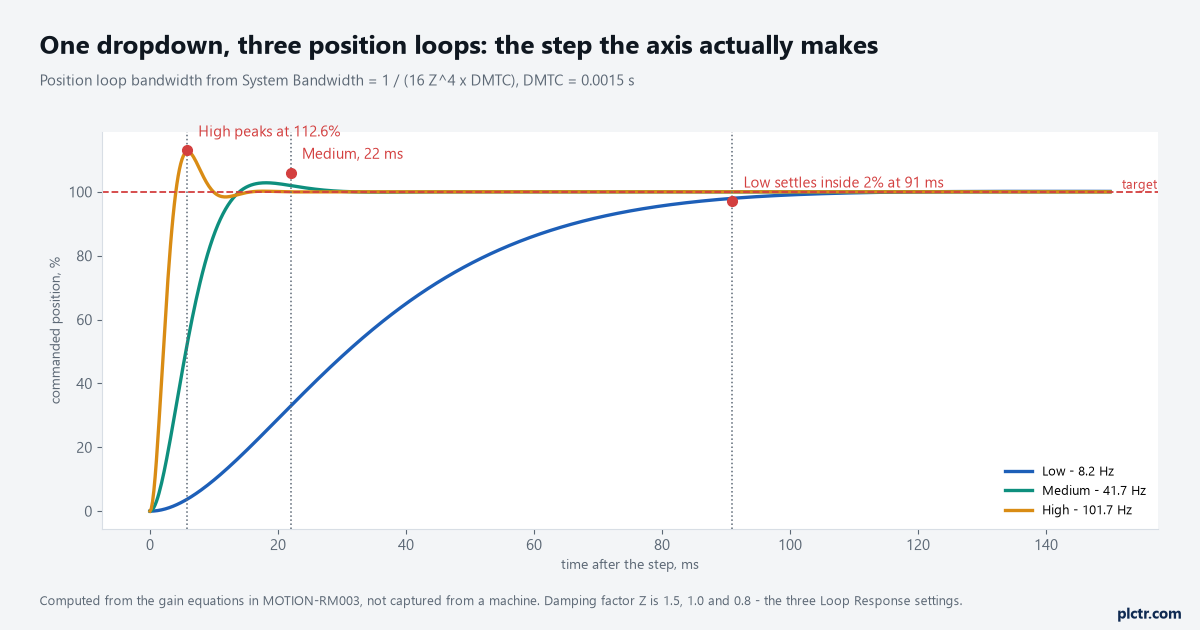
Step response of the same position loop at three bandwidths: 8.2 Hz settling inside two percent at 91 ms, 41.7 Hz at 22 ms, and 101.7 Hz peaking at 112.6 percent before settling at 9 ms, all against a target line at 100 percent

Tuning a Kinetix 5700 Axis: Load Ratio, Bandwidth and the Autotune That Lies Loop Response on the General page of a Kinetix axis is a three-item dropdown, and on a drive with the default 1.5 ms model time constant it moves the position loop between 8.2 Hz and 101.7 Hz. That is a factor of … Read more

Driving a Motor from a ControlLogix: From a Rung to a Turning Shaft on a Kinetix 5700

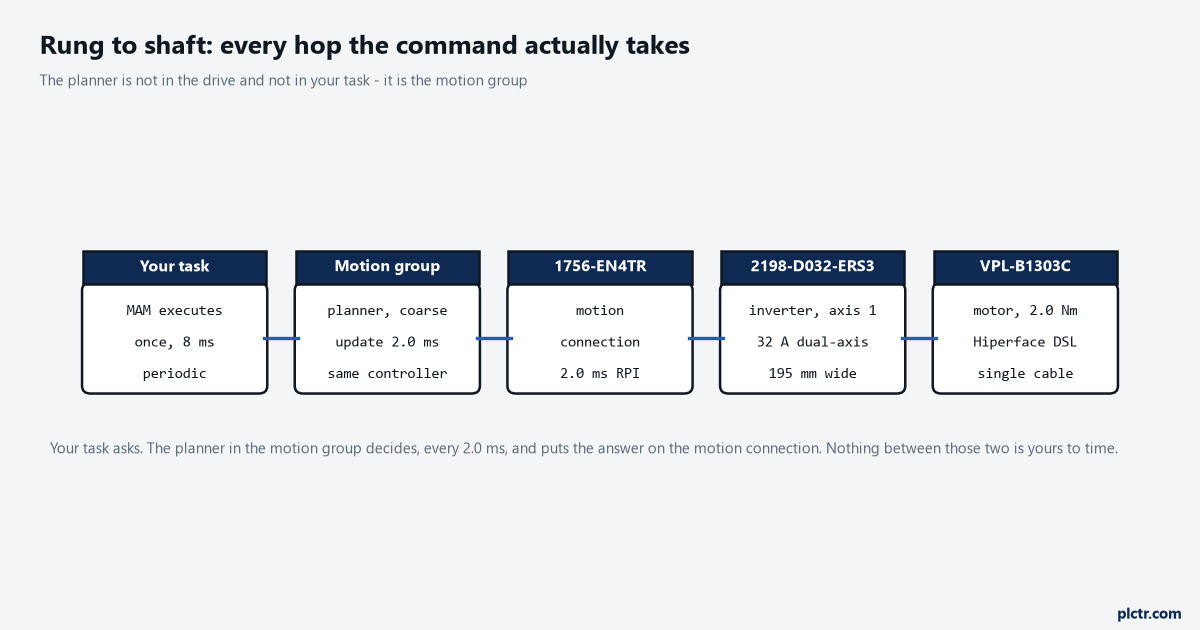
Five boxes left to right: Your task with MAM executing once in an 8 ms periodic task, Motion group with the planner and a 2.0 ms coarse update in the same controller, 1756-EN4TR carrying the motion connection at a 2.0 ms RPI, 2198-D032-ERS3 inverter axis 1 rated 32 A, and a VPL-B1303C motor at 2.0 Nm on a single Hiperface DSL cable

Driving a Motor from a ControlLogix: From a Rung to a Turning Shaft on a Kinetix 5700 A 2198-D032-ERS3 inverter, a VPL-B1303C motor on one Hiperface DSL cable, and a 1756-L83E that has never carried a motion group. Two rungs will turn that shaft — an MSO and then an MAM — and neither is … Read more

MAH and Homing a Kinetix Axis: The Switch, the Marker, and the Home That Lands in the Wrong Place

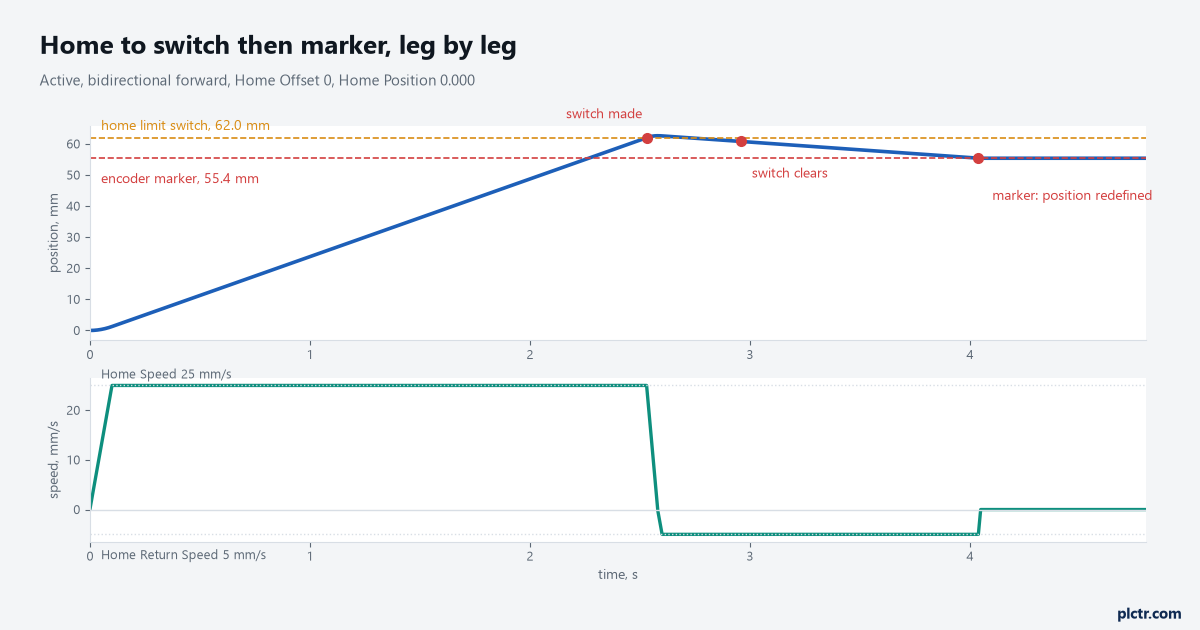
Position and velocity against time for a home to switch then marker: forward at 25 mm/s to the switch at 62 mm, reverse at 5 mm/s until the switch clears, on to the marker at 55.4 mm

MAH and Homing a Kinetix Axis: The Switch, the Marker, and the Home That Lands in the Wrong Place A home-to-switch-then-marker sequence at a Home Speed of 25 mm/s and a Home Return Speed of 5 mm/s takes just over four seconds on a 2198-D032-ERS4 axis, and 1.5 of those seconds are spent crawling back … Read more

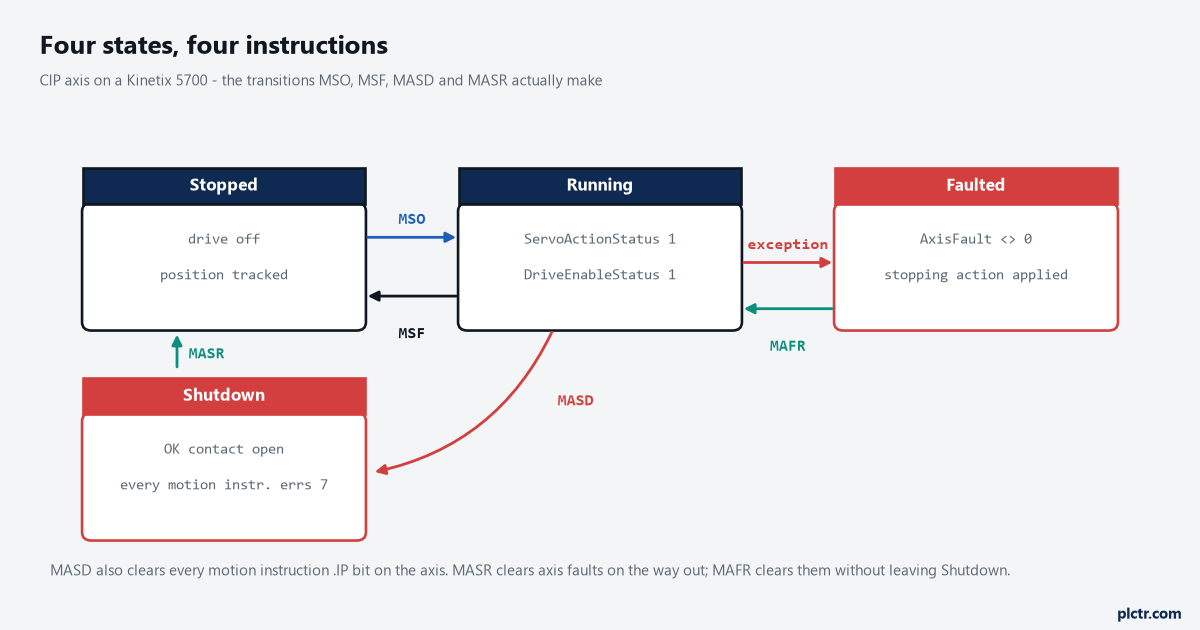
MSO, MSF and MASD on a Logix Axis: Enabling It, Dropping It, and the One That Opens the OK Contact

Four boxes - Stopped, Running, Shutdown, Faulted - with MSO, MSF, MASD, MASR and MAFR on the arrows between them

MSO, MSF and MASD on a Logix Axis: Enabling It, Dropping It, and the One That Opens the OK Contact An MSO against a 2198-D032-ERS4 axis sets ServoActionStatus and DriveEnableStatus, and it does not set its own .DN bit in the scan that fired it. On a 2 ms coarse update period the drive answers … Read more

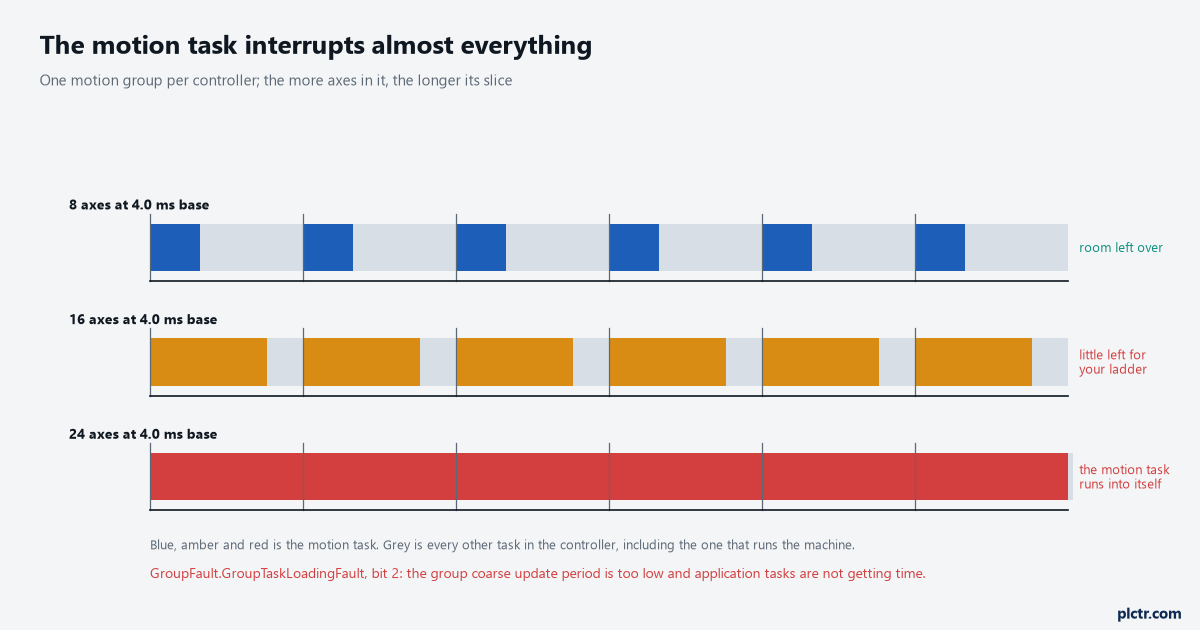
The Motion Group and the Coarse Update Period: What Happens When You Ask for Too Much

Three timelines of a 4.0 ms base update period with the motion task drawn as a coloured block at the start of each period and everything else in grey: eight axes leaving most of each period free, sixteen axes leaving little for the ladder, and twenty-four axes where the motion task fills the whole period and runs into itself, annotated with GroupFault.GroupTaskLoadingFault bit 2

The Motion Group and the Coarse Update Period: What Happens When You Ask for Too Much Bit 2 of MOTION_GROUP.GroupFault is GroupTaskLoadingFault, and the motion instruction reference describes it in plain words: the group coarse update period is too low, and user application tasks are not getting enough time to execute. That is a 1756-L84E … Read more

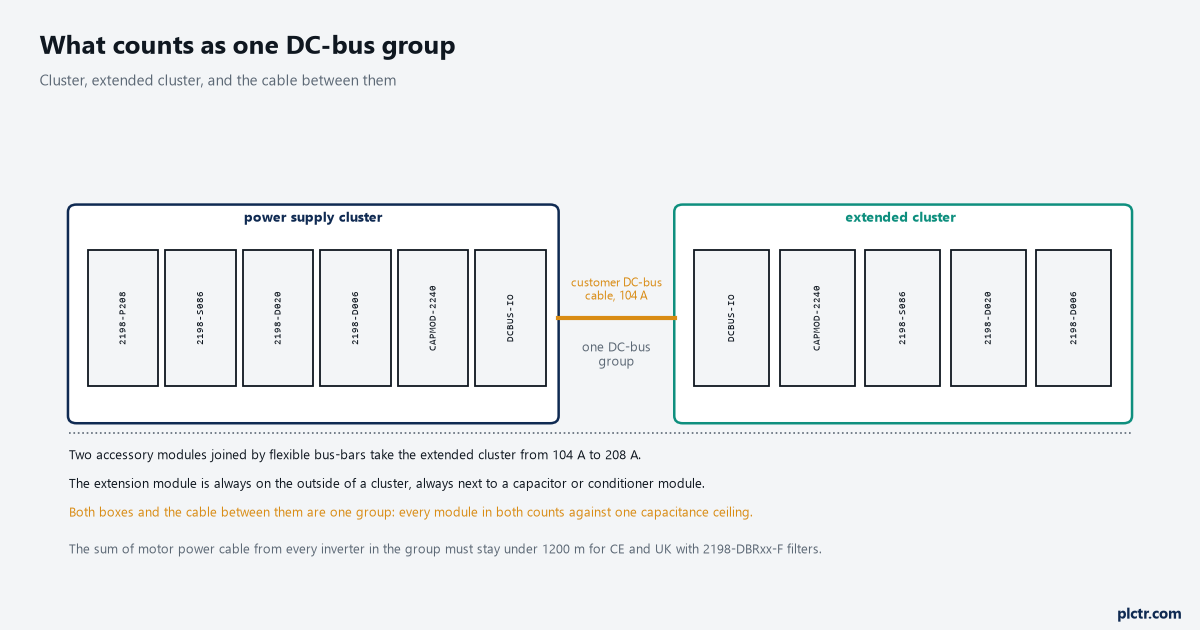
Kinetix 5700 DC Bus Sharing: What the Bus Supply Carries and Where the Limit Is

Two boxes joined by an orange cable: a power supply cluster holding a 2198-P208, a 2198-S086, a 2198-D020, a 2198-D006, a 2198-CAPMOD-2240 and a 2198-CAPMOD-DCBUS-IO extension module, and an extended cluster holding the same accessory pair followed by three inverters, with the customer-supplied DC-bus cable rated 104 A between them and the note that both boxes are one DC-bus group

Kinetix 5700 DC Bus Sharing: What the Bus Supply Carries and Where the Limit Is A 2198-P208 supports 13,000 µF of total system capacitance and puts out 46 kW continuously. Those are two separate ceilings, they get reached by two different kinds of machine, and on most rails the one that stops you first is … Read more

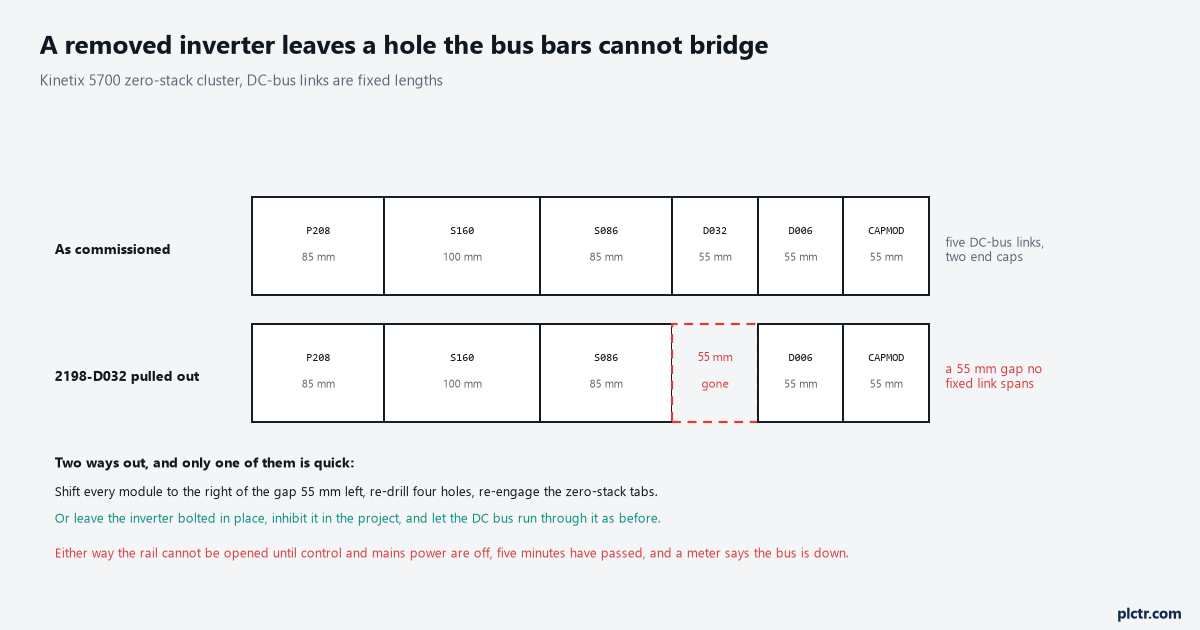
Removing an Axis From a Running Kinetix 5700 System Without Faulting the Rest

A Kinetix 5700 rail drawn twice: as commissioned with six modules from a 2198-P208 through to a capacitor module, and again with the 55 mm 2198-D032 pulled out leaving a dashed gap, annotated with the two ways out — shift every module right of the gap 55 mm left and re-drill, or leave the inverter bolted in place and inhibit it — and the warning that the rail cannot be opened until power is off and a meter says the bus is down

Removing an Axis From a Running Kinetix 5700 System Without Faulting the Rest A 2198-D032-ERS4 is two axes behind one Ethernet connection on one set of bus bars, and inhibiting either half takes the other half with it. Getting the module off the rail is a different order of problem: control power and mains off, … Read more

Adding an Axis to a Kinetix 5700 System: the Module, the Axis, and the Four Places to Set It

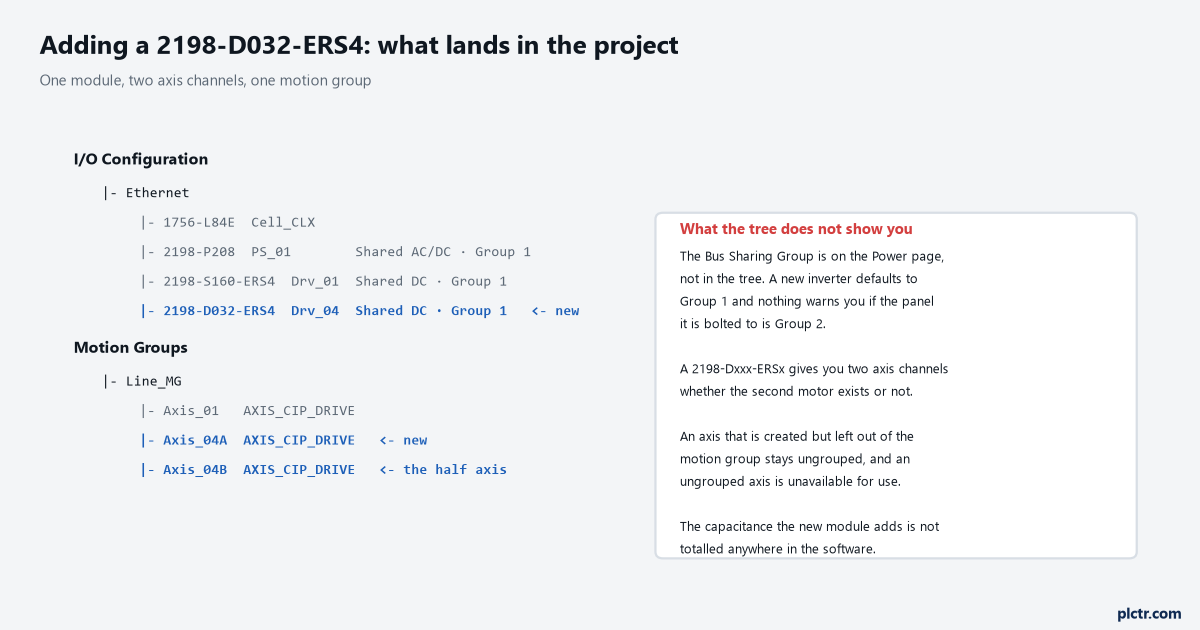
The Logix Designer controller organiser with a new 2198-D032-ERS4 named Drv_04 under the Ethernet bridge alongside a 2198-P208 and a 2198-S160-ERS4, and beneath it a motion group named Line_MG holding Axis_01 plus two new AXIS_CIP_DRIVE tags Axis_04A and Axis_04B, with a panel listing what the tree does not show: the bus sharing group, the half axis, ungrouped axes and the capacitance total

Adding an Axis to a Kinetix 5700 System: the Module, the Axis, and the Four Places to Set It The eighth axis on the line is a 2198-D032-ERS4 in the last 55 mm of the rail, and getting it into the project is four dialogs and about twenty minutes. What takes the rest of the … Read more

Advertisement