A PowerFlex 525 F013 is not the drive being fussy. The drive has measured current leaving the motor circuit for earth, and the only useful question is where. This walks the fault from the keypad to the motor terminal box: what the drive actually senses, how the pattern of the trip narrows the search before you lift a lead, and the insulation test that settles it.
The machine in the example is a washdown transfer pump, 3 HP, 480 V, motor on an outdoor pad with its own junction box, tripping F013 on the first start every morning and running clean all day after a reset.
What the drive is sensing
The three output currents into a healthy motor add up to zero at every instant. Anything else has found a path out of the circuit, and on a 480 V system that path is to earth through insulation that is no longer doing its job. The drive watches for that imbalance and stops, fast, because the alternative is letting a fault current find a person or weld a winding.
Two things follow. There is no sensitivity setting to turn down, and you would not want one. And the drive is not a diagnostic instrument: it tells you there is a leakage path, not which of the motor, the cable, the terminal box or its own output section owns it.
Swapping the drive is the reflex and it is worth doing once, because it costs twenty minutes and clears the drive from the list. A second drive doing exactly the same thing at the same time of day is a result, not a coincidence. That is the point where the search moves past the panel door.
Let the pattern narrow the search
Log a few trips before you touch anything. When F013 happens is most of the diagnosis.
| Pattern | Where it usually lives |
|---|---|
| First start after a cold damp night, clean all day afterwards | moisture in the motor terminal box or the winding ends, dried out by run heat |
| Every start, at every temperature | winding or cable damage, or a lug touching the box |
| Only after a washdown or a wet cleaning shift | water tracking into the junction box or down a conduit |
| Only at high speed or on hard acceleration | insulation breaking down under voltage stress, often with a long cable |
| Started when the motor or cable was last disturbed | a pinched conductor, a crushed gland, a lug screwed onto insulation |
The morning pattern on the transfer pump is the clearest of them. Nothing in the drive knows what time it is. Something in the motor circuit is different at six in the morning than it is at ten, and on a river site in fog season the difference is water.
Megger the motor and the cable, cold and then warm
One insulation reading proves very little. Two readings, taken hours apart on the same leads with the same instrument, prove a great deal. Do the cold one before anybody starts the machine.
Before any of this, the electrical work. The drive comes off the line, the disconnect is locked and tagged, and the bus is given at least three minutes with the charge indicator out before a tool goes near the terminals. Prove dead with a meter rated CAT III 600 V or better, checked on a known source before and after. Work in arc rated clothing with a second person aware of what you are doing. A 500 V test set is itself a hazard: nobody at the motor end, the far end of the cable guarded, and every conductor discharged to earth after each reading, because a few dozen metres of motor cable holds a charge that will find you later.
- Disconnect the motor leads at the drive output terminals. Never apply a test set to a cable that is still landed on a drive. The test voltage has nowhere to go except the output stage.
- Test at 500 V DC for a 480 V machine, which is what IEEE 43 asks for on windings rated below 1 kV. A 1000 V setting on the shop instrument is the wrong tool here.
- Read each phase to earth, hold it for a minute, and write down the value with the time and the winding temperature. A reading that keeps sliding downward while you hold it is wet insulation announcing itself.
- Discharge the conductors to earth afterwards, then land the leads again.
- Let the machine run an hour or two. Then lock off, prove dead, lift the leads a second time and repeat exactly the same test.
- Compare. IEEE 43 puts the floor for a 480 V winding at 5 megohms at 40 C, and a healthy small motor with a short cable normally reads far above that.
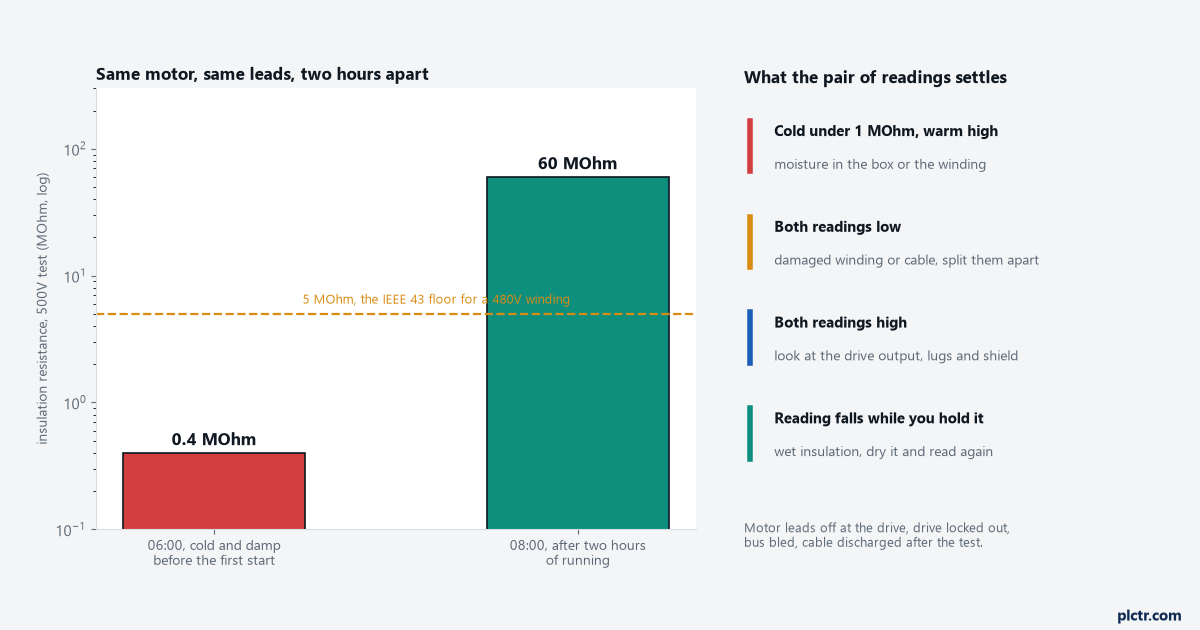
The pump read 0.4 megohm cold and 60 megohm after two hours of running. That gap is not a marginal motor. It is water that the running heat drives back out of the insulation, and it is the drive being right every single morning.
If both readings are low, split the circuit. Open the motor terminal box, disconnect the leads there, and test the cable on its own and the motor on its own. One of them will be the low one, and you have halved the job. Cable and grounding practice around drives is its own subject, and DRIVES-IN001 is the document to have open for shield landing, gland practice and separation.
Open the motor terminal box
On any outdoor or washdown motor this is where the money usually is. Look for the gasket flattened to paper and no longer sealing, the drain hole in the bottom of the box with no drain plug or with a plug fitted in the wrong hole, water standing in the bottom, corrosion on the lug faces, and phase leads pushed so tightly together that the tape has worn through.
Dry it properly rather than chasing it out with a heat gun for five minutes. New gasket, drain fitted in the low point as the motor sits, conduit dressed so water cannot run down it into the box, and a drip loop where it enters. Then read the insulation again cold the next morning and see whether the number has moved.
Field notes
The good drive in the bad bin. The spare that got swapped in during the hunt on the transfer pump was tagged faulty and put on the shelf, because it had thrown F013 too. It was perfect. Anything pulled during a chase gets megger evidence attached to the tag now, or it goes back into stock.
A lug on insulation. A conveyor gearmotor tripped F013 on every start after a rewind. The rewind shop had landed a lead so the crimp barrel sat hard against the earthed box wall, with only the heat shrink between them. It read fine with the leads relaxed on the bench and failed as soon as the cover was bolted down and the leads were pushed into place.
Cable length blamed for a real fault. A crew decided a 60 m unshielded run was causing nuisance ground fault trips on a fan drive and asked for the detection to be relaxed. The megger said 0.9 megohm on the cable alone. A trench had been dug across that run months earlier, and the cable had a stone bearing on it. Long cables do add charging current to earth, which is why shielded cable with a symmetrical earth and a sensible switching frequency matter on a long run. That did not make this one a nuisance.
Frequently asked questions
Can F013 be made less sensitive on a 525?
No, and that is the right answer. Ground fault detection on a drive protects the motor and whoever touches it. If the drive is tripping, something is leaking.
Does a megger damage a drive or a motor?
Never test through a drive. With the motor leads off and a 500 V test on a 480 V machine, the winding is fine. Instrument transformers, surge capacitors and electronics in the circuit are not, so know what is on the far end before you press the button.
The motor reads 2 megohms and runs. Do I replace it?
Not on that reading alone. It is below the IEEE 43 floor, so it is a machine on borrowed time. Dry it, read it again, trend the number, and plan the change while the line is down anyway rather than at three in the morning.
Next step
Once the reading is back where it belongs, trend it instead of testing it during breakdowns. A quarterly insulation reading against the same leads at the same temperature turns the next F013 into a curve you already saw bending, which is the approach in PLC condition monitoring and predictive maintenance. The drive side of motor faults, and how the controller should handle them, is in PLC motor control and drive systems, and the general method of working a fault from symptom to cause is in advanced troubleshooting techniques for PLC systems.