The Feedback Fault That Is Not the Encoder: FLT S45, the DSL Cable and the Ground That Hides It
A 2198-D020-ERS3 running a VPL-B1306F has thrown FLT S45 – FDBK COMM FL four times in six weeks, and there is a third motor on order. The drive has been measuring the actual cause the entire time, on a screen two button presses from the home page, and nobody has looked at it.
Open Diagnostics, then Encoder, and read LINK QUAL and RSSI.
FLT S45 is a count of missed or corrupted serial data packets coming back from the feedback device, measured against a factory set limit. That is a statement about the link, not about the encoder. The encoder has its own fault code — FLT S47 – FDBK DEVICE FAILURE, with a two-digit sub-code naming exactly which internal check failed — and if the device had detected something wrong with itself, that is the code you would be looking at.
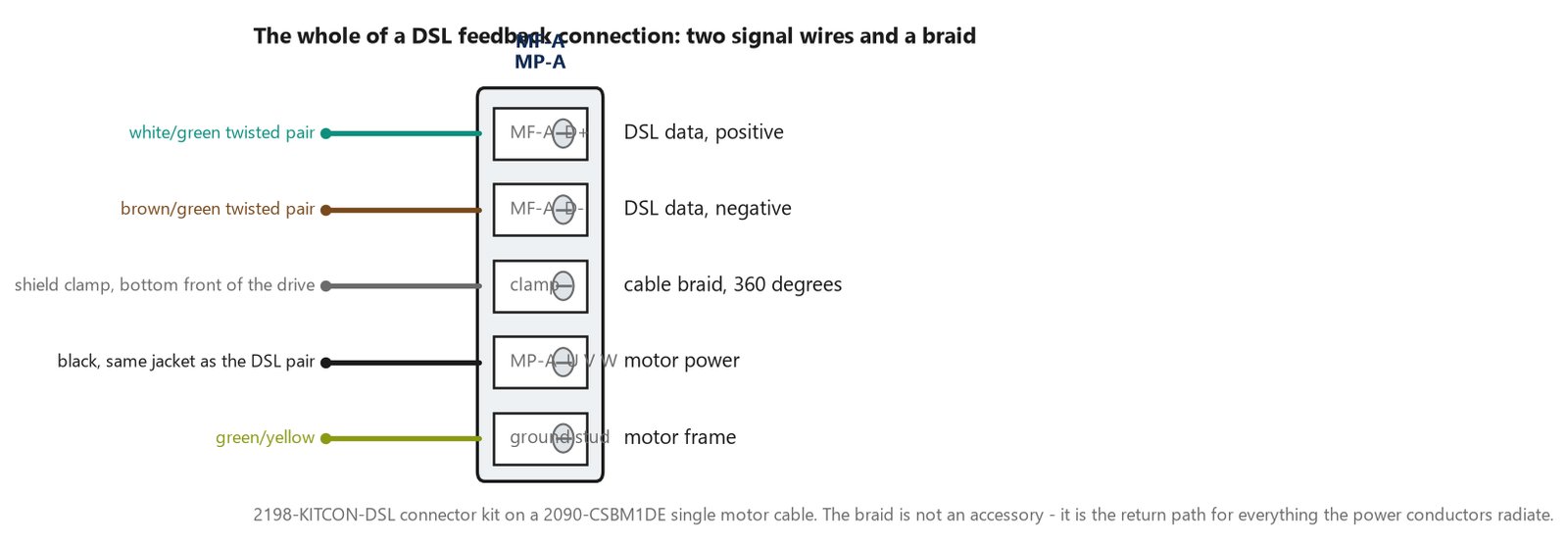
Two signal wires and a braid. On a single-cable motor the DSL pair shares a jacket with the motor power conductors, which is the whole reason the braid termination has to be right.
Which code you have decides whether the motor is guilty
Six codes cover feedback on this platform and they do not mean the same thing. FLT S41 – MTR AQB STATE FL is feedback signal noise: the number of illegal state transitions on a quadrature encoder’s signals has passed a factory limit, which only applies if you are running AQB feedback rather than DSL. FLT S43 and FLT S44, the feedback loss pair, watch the voltage levels of the A and B channel signals and fault when they drop below a limit — and the footnote on both is the one that saves time, because they apply to every compatible feedback device except DSL. FLT S45 – FDBK COMM FL applies to DSL and Hiperface devices and counts bad packets against the factory limit. FLT S46 – FDBK COMM UL is the user limit version and, printed in the same table, applies to everything except DSL. FLT S47 – FDBK DEVICE FAILURE nn is the device itself reporting an internal error. And NODE FLT 03 – HARDWARE 02 is the case where the drive could not establish communication with the encoder at all.
On a single-cable Kinetix VP motor with DSL feedback you will never see S43 or S44 at all.
Two of the six codes are the device. The other four are the wire between you and it.
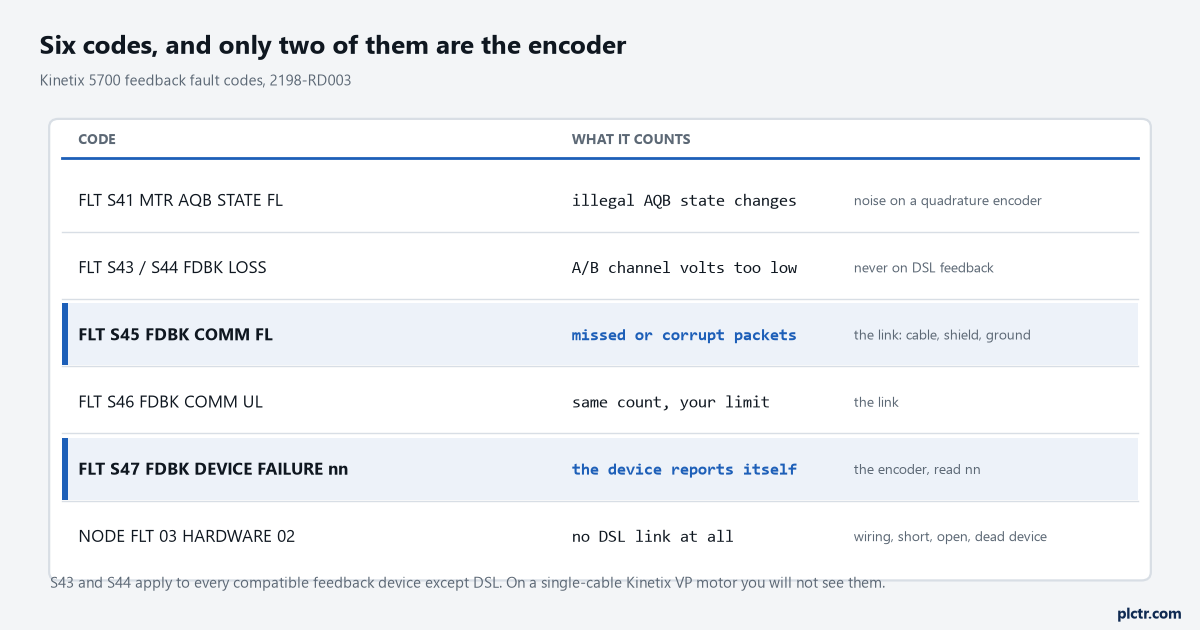
The footnotes are the useful part. Knowing that S43 and S44 cannot happen on DSL removes two codes from consideration before you start.
The two numbers that settle an FLT S45
Under Diagnostics the inverter offers an encoder page, and past the serial number and the resolution it carries four readings that exist nowhere else in the system. LINK QUAL is the quality of the DSL link measured at the drive end, and the manual’s requirement is not a range — it must always read 100 %. RSSI is the same link seen from the other end, reported by the encoder inside the motor, and that one is allowed a margin: keep it between 80 and 100 %. POS ERRORS is a running count of errors on the primary position feedback channel of the DSL link, and CHNL ERRORS counts them on the secondary communication channel. Together they turn an intermittent fault into a measurement you can take with the machine running and healthy, hours before the next trip. And the manual is unambiguous about what a low reading means, in both places it appears: persistent values below those limits indicate a poor feedback ground connection.
Not a failing encoder. A ground.
An encoder reporting 96.4 % link quality is answering every question it is asked. It is being shouted over.
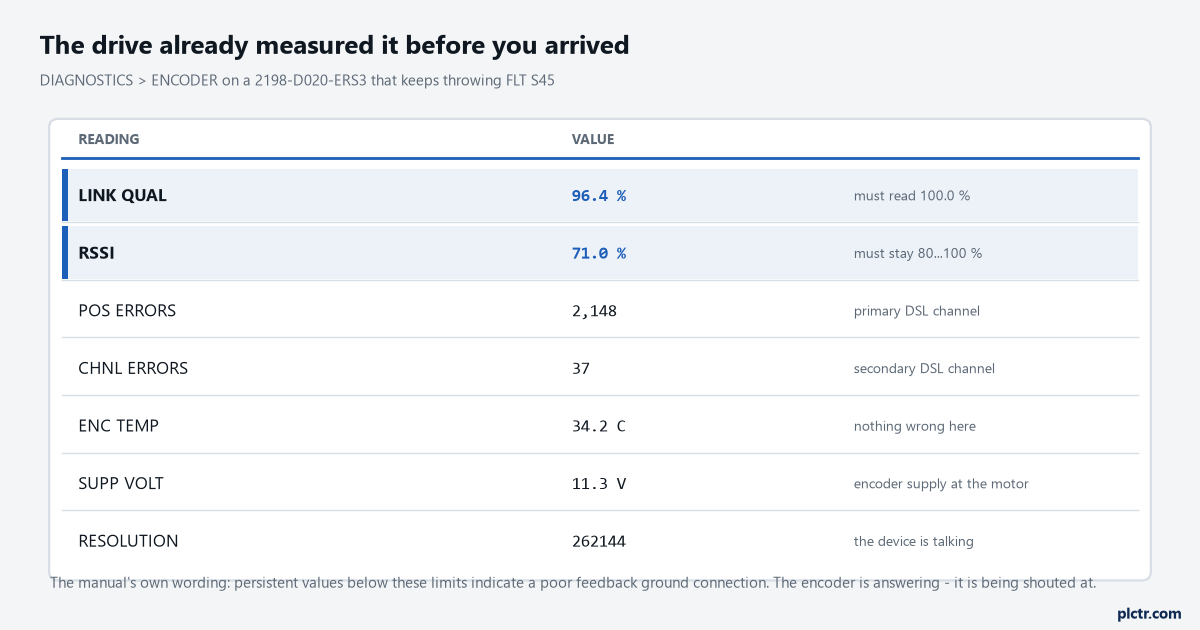
The encoder is alive, at a sensible temperature, on a sensible supply, reporting its resolution correctly. Everything about it is fine except how well it can be heard.
The ground path, joint by joint
The braid is not a wrapper, it is the return path for everything the motor power conductors radiate, and on a single-cable motor those conductors are a few millimetres away inside the same jacket. Factory-supplied Kinetix 2090 single motor cables come with a section of jacket already stripped to expose the braid, and that exposed area is meant to be clamped — with the clamp that ships on the drive — at the bottom front of the module. Above that the chain continues and every joint in it is a high-frequency bond rather than a safety earth: the drive chassis to the subpanel, which is why the manual asks for zinc-plated paint-free steel and tells you to scrape the paint around each fastener on a painted one; and the subpanel to the cabinet, top and bottom, using wire braid of 25.4 mm by 6.35 mm, with the rule of thumb stated plainly — the wider and shorter the braid, the better the bond. One painted washer anywhere in that chain and the braid is decorative.
The motor frame has to be properly grounded too, and that is the third item on the spreadsheet’s own list of solutions for FLT S45.
It sits directly under “check motor power cable and feedback wire shields are secured correctly”, which is the second.
This is a different problem from a genuine earth fault, where current is actually leaving through the ground conductor — finding a drive ground fault without guessing is that job, and it needs a meter rather than a torque wrench.
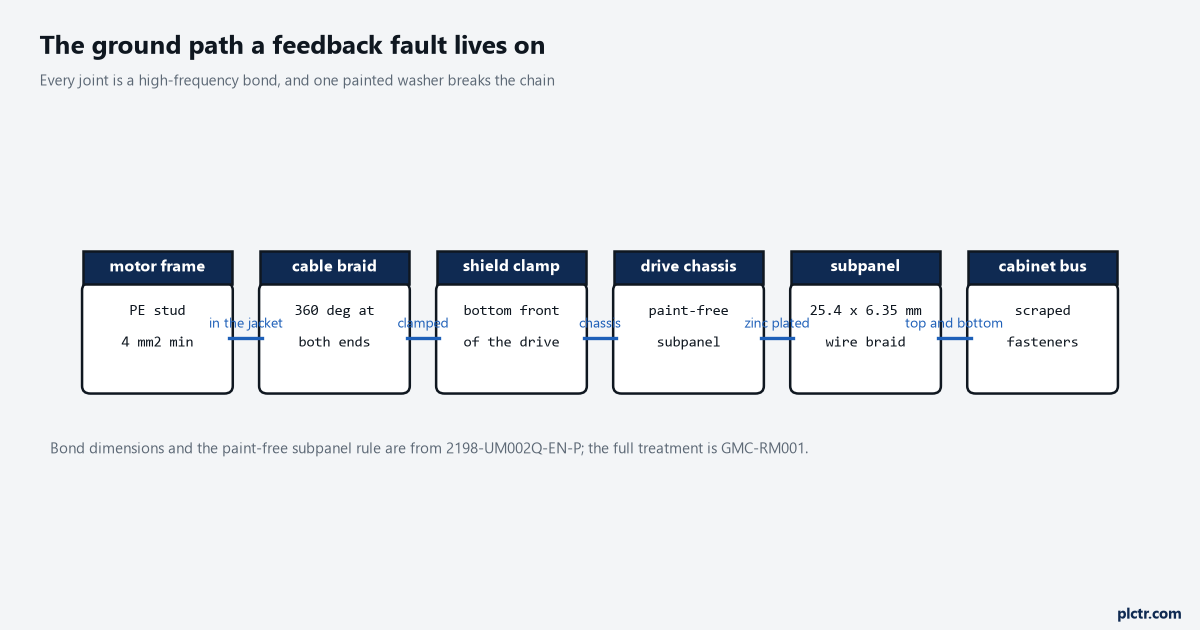
Six joints between the encoder and the cabinet earth. The fault is normally at whichever of them somebody was in a hurry about.
Where the cable is allowed to run
The Kinetix 5700 installation splits the enclosure into three zones, and the feedback cable’s zone depends on which cable you have. The clean zone sits to the right of the drive system and carries digital input wiring and the Ethernet cables; the dirty zone is left of and below the system and carries the circuit breakers, the 24V DC supply, the safety wiring and the motor cables; the very dirty zone is limited to where the AC line filter output jumpers across to the bus supply. On a single-cable motor the feedback conductors are inside the motor cable, so they are in the dirty zone by construction and there is nothing to decide. The exception is worth knowing because it is easy to get wrong on a retrofit: where a 2198-H2DCK feedback converter kit or a 2198-K57CK-D15M universal feedback kit is used, the separate feedback cable routes in the clean wireway. And where there is not enough room to keep 150 mm between the module and whatever is next to it, the manual’s answer is a grounded steel shield rather than a shrug.
A feedback cable tie-wrapped to a motor cable for two metres is a decision somebody made by accident.
When it really is the encoder, the sub-code says so
FLT S47 is not one fault, it is a family, and the two digits after it are the diagnosis. On DSL feedback the list runs from 01 acceleration overflow through 05 vector length error, 06 counter error and 07 synchronisation error, up through the multi-turn errors in the teens, and into the critical group: 48 critical temperature, 49 critical LED current, 50 critical supply voltage, 51 critical speed, 52 critical acceleration. Two of them have handling notes attached that will cost you time if you do not know them. Sub-code 88, position out of range, needs a control power cycle to reset and will not clear any other way. And on a 2198-H2DCK feedback converter kit, a Motion Axis Fault Reset is required and can take up to 30 seconds to complete, with cycling control power explicitly noted as not always fixing it — which looks exactly like a dead drive if you give up after ten.
49 is a light source that has aged. 50 is the supply at the motor end, and that one is often cable again.
Even here, the spreadsheet’s own solution list for FLT S47 opens with the cable and the connector and only reaches “replace motor if fault continues” at the end of six items.
The manufacturer puts replacing the motor last. That is worth carrying into the conversation with production. If you have ever wired feedback into a counter input, the shielding discipline in wiring an encoder to a high-speed counter input is the same argument at lower voltage.
The dead end everybody walks down first
The fault says feedback, the feedback device is in the motor, so the motor gets changed. It works. The machine runs for a shift, sometimes a week, and then the same code comes back on a motor with forty hours on it, and by then the original has been sent away and nobody can prove anything. The reason the swap appears to work is that changing a motor means unplugging and re-seating the feedback connector and re-clamping the braid, which temporarily fixes the actual problem. If a motor swap is genuinely on the table, take LINK QUAL, RSSI and both error counters before you unplug anything, then take them again on the new motor. Two sets of readings turn an argument into a measurement.
Before the next one, read the encoder diagnostics page with the machine running normally and write the four numbers on the panel door. If LINK QUAL is below 100 % or RSSI is below 80 % while everything is apparently fine, you have found the fault in advance, and the job is a torque wrench and a wire brush rather than a motor. The drive’s other diagnostic screens, and what the fault log holds that the controller does not, are in reading a Kinetix 5700 fault at the drive; if the axis is also throwing position errors, the noise this puts into the loop shows up as the fifth shape in position error and what the trend says.